Tuesday, November 19, 2013

The Hero... Just Because!

Recently I picked up Gyrozetter for the Nintendo 3DS, which is a multi-media project from Square-Enix that has, alongside the 3DS title, an arcade game, an anime, and a manga series. I chose Gyrozetter solely because of it being multi-media. As someone who is constantly playing games in a language I don't understand, I thought it'd be nice to actually be able to know the story for a change. And so, prior to starting the game, I've begun watching the anime series--- which has resurfaced a doubt I've still yet to answer.
"I'm the Hero! ---Just because!"
In the first episode, protagonist Kakeru Todoroki performs two actions that are applicable to the beginning of many Japanese videogames. In Gyrozetter, the theme is cars; it takes place in a futuristic city built around advanced roadway systems, and here children are also allowed to drive cars (for some reason or another). The series opens up with all the children practicing parallel parking; one girl does it properly, and another girl botches it. When Kakeru's turn comes up, he boosts his car to max speed, spins the car multiple times, and lands in the specified spot perfectly; for whatever reason, this boy is supernaturally skilled at stunt-driving. He then gets out of the car and says, for the first of many times to come, "I'm the hero!"
It's later revealed that he really is the hero. The school is also a secret military base that is looking to pick out super drivers to pilot cars that also morph into combat-robots. There's a token prophecy behind all of this as well that literally spells out that this fifth-grade boy is "the one" and that he is destined to become the bees-knees and set forth on a life of adventure, excitement, and everything that normal people might just end up killing themselves over because they'll never have such experiences.
--and I believe it. No matter how many times I've come across this in anime and videogames, the sudden "Hero-Because" set-up always wraps me in. And while I don't think there's anything wrong with this design, what bothers me is that each time I've tried to analyze this set-up critically, or to study the way it is implemented in media, it appears both extremely transparent and utterly void of character. What bothers me is that there is nothing less interesting than a character who is simply handed fate and excitement on a silver platter--- except there is so much material in the form of successful videogames and anime that proves this wrong that I'm not quite sure what to believe in terms of what is quality, and what is negligent, story-telling.
How Fortunate for You...
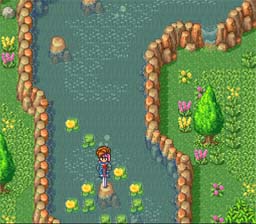
To be fair, this form of story-telling is not exclusive to Japanese videogames. As pictured above, the propulsion of Secret of Mana's beginning is of course rooted in King Arthur legend, and the story of "Alice in Wonderland" uses the very same Hero-Because set-up as well; she is sitting on a bank, sees something fantastical, follows it into a hole, and begins her adventure (all on a single page). But whether it's King Arthur, Alice, or Kakeru, what is apparent is that these people have not really earned anything that justifies their glorious adventure. They are people who just so happen to have a skill, whether it's royal bloodline, otherworldly imagination, or a keen understanding of how to drift properly; it's something beyond learning. These are abilities and talents that are outside of reach for a normal human-being, an innate understanding bestowed by lineage, genealogy, or, most damning of all, fate.
What I wonder is: Why on Earth do we root for these fortunate do-gooders? What exactly is it that makes so borderline supernaturally-gifted people the hero? Is it truly because they are moral, that they reflect what is the established good? Rather, how can something so simple as being moral, something that most of us strive to achieve in some fashion or another anyway, be the sole conduit of making a person that is, quite simply, better than you and me, a person to admire and respect? Perhaps my own vision of humanity is skewed, but from what I've gathered is that man's goal, outside of his biological ticks like survival and reproduction, is to achieve greatness. As man being conscious is the catalyst for his utmost fear of dying, is not the most consistent feature amongst human-beings the desire to be great, to achieve something that will ensure memory of one's own legacy and actions long after their death?
But if the hero is someone who doesn't need to do anything but continue to exist and receive the bounties that come their way, to be entitled immortality solely for following the path so favorably bestowed them, isn't that the very antithesis of being an admirable human-being? Is not real greatness the struggle to reach the point of success? To dictate and command one's own journey, and to battle against the fates and societal pressures prescribed them? Why then do these characters, who have never considered the pursuit of greatness but instead were simply delivered the end-result in form of their adventure begun, receive our attention and love?
Vaati is compelled by both personality and reasoning. Link--- just because.
As is often the case, a well-handled villain embodies far more human and intriguing characteristics than the hero, namely in flaws and inventiveness. In the case of Vaati in "The Legend of Zelda: Minish Cap" there is delivered probable reason in the form of his motivating history. Vaati's own pursuit of wisdom leads him to recognize the darkness in humanity, and how it is not monsters that are the greatest evil, but human-beings. By setting out to obtain greatest power so that he may cleanse the world of its true darkness, Vaati upholds a far more sturdy rationale than the hero Link, who sets out to stop Vaati because--- well, just because.
The obvious reason why villains are not the protagonist is that they must express a bias that will ultimately alienate their audience, be them readers, gamers, etc:. Even in the case of Vaati, a fan-favorite amongst Zelda fans, the idea of having him as the "hero," with the goal of achieving supreme power so that you may eventually commit mass-genocide, doesn't necessarily sit too comfortable as motivation to "win."
Amnesia: Formula for Moral Perfection
But is the alternative truly the plain-faced moralist who hasn't any reasoning? Rather, that isn't allowed reasoning? As is expressed with villains, it takes only a single bias, a subtle crook in the way one views the world, to obtain a direction that, while intrinsically human and probable, is also skewed and therefore dirtied, unfitting the golden-clad adventurer who strides solely ahead, never doubting nor faltering as his pursuit is at all times obliging the conduct of "goodness," the ideal of conventional structuring and societal order. No matter his manner-less disposition, the moral hero bathes in the support and favoritism by the many who fail to recognize his innate, real structure. While goodness, and reward for being good, may enlist some idea of reasoning, one need only look at the very heroes they are supporting more closely to see how false this truly is; dullards, the creatively drained, automatons in military-step painted the shade of a nation's flag, a religious cult, a consumer trend, etc:. The moral hero is a psychological trigger, a propaganda tool that obliges the same group-think idiocy that propels conventional morality to this very day.
Is not the established good questionable? In the famous quote "One man's terrorist is another man's freedom fighter," is not the same paradox applicable here? How are we, the audience, to understand that the moral hero is truly moral without greater recognition of the many universal elements surrounding their world? Rather, why do we accept the moral hero as being the paragon of justice? Perhaps the world has earned its apocalypse, or perhaps the comfortable kingdoms and societies within that world do deserve destruction. Hasn't the growth of societies throughout all time come by revolution and dismantling of the prior-established good over and over again? Why do we ignore these realities repeatedly just to follow a faceless dunce who hasn't even the ability to contemplate their own actions and the results that follow? There is no greater coward than the moral hero; they are the disease of reactionary thought.
---so why the heck do we, I, love them?

Sunday, November 10, 2013

Gaist Crusher (3DS) - Demo Impressions

Capcom's upcoming title, Gaist Crusher, a multi-media series already dipped into anime and manga adaptations, has recently outfitted itself with a demo on the Japanese E-Shop. With a tutorial, three single-player missions, and a segment where gamers can try out their real-life "Gai-Metals" (think Skylander toys), there's a sizable degree of content in the Gaist Crusher demo, and provides a trial as intriguing as it is enjoyable.

*Note: I do not have any of the purchasable Gai-Metals, which can unlock an additional mission and Gaist Gears for this demo.*
Being touted as a "Monster Hunter for Kids," from what is gleamed in the demo is that Gaist Crusher isn't really that. Capcom's other 3DS (and PS3) entry, E.X. Troopers, offered a much closer likeness to an MH-Lite than what is seen from Gaist Crusher here. Instead, Gaist Crusher appears to be little more than a heavily stripped down action-game that obliges basic RPG-tropes like Elemental weakness'/strengths, a leveling system, and very little else (within this demo, remember). While the game boasts some very detailed and interesting settings, from the three available stages the player's sole interaction with the environment is to proceed from one checkpoint to the next. There aren't collectibles nor interactive options anywhere on the three maps; the player solely proceeds along the prescribed path, battling enemies after activating each checkpoint before eventually culminating into a boss battle. In terms of calling this a Monster-Hunter game, the lack of player-interactivity with the map mostly negates that similarity.
What Gaist Crusher does have going for it is that the graphics are excellent, and that the gameplay, while limited, works very well. While Gaist Crusher won't go breaking new-ground with it's spiky-haired heroes and elemental color-tonalities, it still hits the intended mark of being colorful and lively, independent in the meaningful places (particularly your characters costumes/weapons), and expressing an inspiring excitement as the player battles and proceeds. While the actions and attacks are animated terrifically, I think the success of the art-direction is expressed best when your character is venturing between checkpoints; the camera zooms in, and your characters speed increases just enough to summon wind-streaks. It's a small thing, sure, but it's one of those meaningful additions that so often turn an "Okay" game into one memorable.
The battle-system is very simple, but fortunately that simplicity is expertly applied. All Gaist Gears (combat outfits) have three forms, the first being a hand-to-hand brawler and the second being weapon-equipped. Both of these forms have only three attacks that may or may not be applicable to combos, and ultimately follow the weak/medium/heavy structure. What separates the two forms is that only in brawler form can the player guard against attacks, and only in weapon-form can the player dodge/evade. It's a small divide between the two, but in Gaist Crusher these seemingly arbitrary differences are what compose the experience. One of the bosses in the demo, an Electric Black Dragon, was absolutely devastating me. Realizing that evading was not working, I chose to take the fight more slowly in Brawler form so that I could guard against his unavoidable tail-spin attack. Sure enough, my swapping evade for guard, as well as speed for patience, was the very thing needed to conquer the boss. It's in the small decisions like this that Gaist Crusher takes on a Monster Hunter aesthetic; the bosses are as much a puzzle to be solved as they are a punching bag, and it's up to the player to discover and apply the strongest strategy per battle. It's a rewarding design that truly makes the player not only rejoice at having conquered a challenge, but also the fact that they used their own genuine human-intelligence to do it.
The third battle-form is as pictured above; throughout each level the player will build up power to perform either a special attack (a singular, super powerful attack), or to transform into Extreme Mode. Extreme Mode has the player become a mammoth creature for a brief period of time where they can simply devastate enemies and bosses alike. In the demo, the five available Gaist Gears each have an Extreme Mode applicable to animals, such as an electric shark or gigantic hippopotamus, but there are also two unlockable Gears that allow the player to become something non-animalistic. By clearing a level without dying, the player earns a "Gaist Chance," which is essentially a chest that the player beats open. From the two earned in the demo, both offer the player a new Gaist Gear whose extreme mode is the boss that they've defeated (a cloud-riding genie, and a wind dragon). While I didn't find playing as either boss much more exciting than the animals, I'm sure that Gaist Crusher will have a slew of boss characters that are sure to meet the fancy of each gamer, and getting the chance to play as them will be a nice incentive for striving toward a perfect level-run.
Gaist Crusher's demo leaves a lot of questions though. Each of the Gaist Gears have an attached "Level 10" to them, which would imply some style of leveling up. As none of the defeated-enemies conclude with experience points though, and that there aren't any materials found amongst the maps, exactly how Gaist Crusher handles its leveling system remains a daunting mystery. Furthermore, while the tutorial segment of Gaist Crusher has two side-characters speak to you, the single-player missions are solely gameplay. What the world is like outside of the linear levels is uncertain, and exactly what it offers to accentuate the experience is also unknown.
No less, from this gameplay-focused demo I am extremely excited to get my hands on the full product, little that I understand of the overall game despite. It's simple in all the ways that E.X. Troopers was, and alike E.X. Troopers also capitalizes on that simplicity with expert craftsmanship aimed solely at creating a downright fun experience. Despite this being yet another Capcom entry that leans heavily towards their hugely successful Monster Hunter design, it is looking to be yet another project that succeeds in all the places that its source-material simply cannot go toward, and will offer that unique, adaptive style of gameplay that Capcom does best.

Monday, November 4, 2013

Awful Videogame Ideas that Should Totally Happen

Final Fantasy 7: Shinra Kart Division (PS3/Vita)
Genre: Kart Racing

The Final Fantasy series is in disarray for the western world. For Square-Enix, who chose to not localize Type-0, the game Final Fantasy fans desired, and to make Final Fantasy 13 a trilogy, a game that fans were majority-wise unhappy about and wanted nothing more to do with beyond the original title, it is clear that something wonky is occurring in the Final Fantasy department, and that they're soon to lose even more fans for a once universally beloved series.
So let me ask this; what is the most efficient way to reground interest into a turbulent series? Don't answer; shut up; you're wrong. There is nothing better than Go-Karts!
It's clear that Final Fantasy 7 is the most well-regarded entry in the series. Whether it is the game that made gaming "important," or the game that exemplified "Over-rated-ness" to someone, it really doesn't matter; Final Fantasy 7 is the series' entry most played and known, and is the most logical choice for a Kart racer, a genre that doesn't really do much beside oblige a proven gameplay formula and greedily bathe in tapped nostalgia-pools.
But don't think about that! Instead, forget about those sixty bones you just dropped and gush as Cloud Strife side-swipes enemies with his buster-sword, or Turk-Version Vincent makes an emo-boy sob everytime he bounces. Of course, each power-up, that do the same things that they do in every kart-racer, is cosmetically applicable to Final Fantasy 7 as well. Stuck in last place? Well you've a much higher chance of earning Knights of the Round, where the many summoned warriors will race throughout the entire map and disrupt your opponents! Or maybe you'll earn the Mt. Coral Train-Set, which simply explodes the entire race and creates a draw!
Get excited, Final Fantasy fans; Square-Enix is ready to unleash yet another title that is wholly questionable in its delivery--- except this time you'll be too busy rekindling Aeris memories to bother rioting on the Internet about!


Kirby: I'm Not a Conformist (3DS)
Genre: Word Game 
Kirby's never had his chance. His whole life has been spent trying to live up to the expectations of his creators, pursuing things that everyone else is doing, mimicking all the posers and looking cute and happy when, deep down, he's brimming with severe anxiety. But it's gotten to the point where his aspirin, which he tells everyone is actually Prozac, isn't working anymore. Kirby's simply had it inhaling all the conformist junk and is ready to stand up, read-aloud his unedited free-verse poems, and make the world realize that they totally don't understand him.
One of the things that hardcore gamers critique Nintendo about most is that their titles don't take advantage of using videogames as a more meaningful outlet beyond entertainment, and that Nintendo is in the most prime position to push videogames above the media-prescribed negative connotations but neglects to do so. Instead, Nintendo "plays it safe" by focusing on creating enjoyable pieces of entertainment rather than constructing titles boasting biased philosophies and 3D-rendered tear-stains.
But no more! In Kirby: I'm Not a Conformist! gamers will spend their time constructing poetry that furthers Kirby's pursuit of somewhat individuality and self-esteem by using the Nintendo 3DS touch-screen to write uber-dark poetry. But don't worry; no matter how radical I'm Not a Conformist! sounds, Nintendo knows better than to assume you are as independent as Kirby. Instead, the game offers upwards of two hundred stock phrases for the player to independently choose from; is your poem about "The cry of a sparrow," or the "Blood that Drips from a Fallen Phoenix?" Nintendo has you covered! Don't worry about having to come up with something skillful; the most important thing is obliging Kirby's wholly sincere fit for being recognized as a meaningful (although he will then say he is totally incomprehensible and beyond understanding) individual!


Around the World With: Nathan Drake (Vita)
Genre: Adventure/Education
I've always been confused by education games. As they are, indeed, videogames, and are games that have empirical, practical value beneficial to any person, and offer this practicality in delightful, fun games, you'd think they'd have reached a more successful zenith in the videogame market by now. But they haven't, and there's so obvious a reason why that it's borderline maddening some developer hasn't caught onto it yet:
There aren't any guns and explosions, bro!
In Around the World With: Nathan Drake, the title takes advantage of everything established in the Uncharted series except for Nathan Drake mass-murdering indigenous people of countries he doesn't understand beyond their ancient history. Don't worry, patriots: it isn't that we're "against" Nathan Drake being a pristine Freedom Fighter, but that to meet an ESRB applicable to kids we simply can't have Nathan gun-running entire nations he knows nothing about in his morally-reasonable pursuit of man-handling historically-spared areas.
"But if Nathan hasn't a gun," you ask, "Then how is this fun?" Well we're going to keep everything but Nathan with a gun. By being able to focus more on minimizing international cultures to war-obsessed territories rife with black-and-white personalities, we can create even more cinematics brimming with explosions, retain gorgeous graphics which are clearly the most important thing in a modern game, as well as enlist even more totally not blatantly scripted and meaningless platform sections that the player literally can't fail at; we all know how much gamers like "choice" in their videogames!
So how does this play? You control Nathan, traveling through war-zones inside gorgeous city environments, and manage your way from one education-area to the next. In these peaceful places, Nathan meets up with Sully who then propositions him with a series of challenges to uncover excessively biased culutral and historical facts concerning why whatever place in the world your at is nothing more than violent and irate. These facts are "discovered" by partaking in various puzzles that have you lift a crate from one side of the room to another, or maybe swing on a chandelier as you pick up the several torn pieces of a once cohesive and intelligent text and read only the applicable segments concerning what we decide is reasonable. Don't worry, parochial parents; we'll be sure to omit the part where most third-world dictatorships and violent repressions are financially backed by foreign superpowers with intentions of retaining sweatshop-levels of poverty and economic inferiority to uphold corporate backing; obviously your kids don't need to know about that stuff!!


Alan Wake: Origins (Xbox 360)
Genre: Action-Adventure
Did you know that Edgar Allen Poe was an alcoholic? And F. Scott Fitzgerald? And Charles Bukowski? And many, many more writers also? Of the several artistic fields, creative-writing tends to be the only one conductive of alcohol dependency, an imaginative process that is not consciously but unconsciously present, tapped into solely by degrading one's own brain with a surplus of booze before perceiving the many angles, worlds, and lives present in the imagination.
Enter Alan Wake: Origins. In this prologue, Alan Wake exists prior to his critical success as a mystery author, living day-by-day while working an overnight stocking job at a super-market and hammering out as much of his novel's 1st-draft he can before falling asleep. Every day he is tormented by the many emails of various literary magazines alerting him that his short-stories were "Well written, but unfortunately we cannot use them at this time." Living inside a cramped apartment stuffed on the second floor of a derelict-enthused inn/pub, Alan battles internally his need to construct a manuscript that will launch his career and dream of being a successful writer, and the savory, immediate pleasures present in the hedonistic bar right below his feet. He continues this battle without answer for some time, but eventually the demons of either side come to haunt him both mentally and physically.
In Origins you play as Alan Wake on his nocturnal weekends, which he christens by having three or seven beers with his Wheaties before stumbling out for a moonlit stroll. As a writer, Alan is obviously an introvert, and so instead of going to clubs or late-night coffee-shops Alan spends his time wandering pitch-black woods and shadowy lakes. It is here, in dark and desolate places, that Alan's inebriated fantasies come to life in the form of murderous and paranormal entities, leading him toward either the continuity of his craft as a writer, or into the negligent, forgettable slums as a drunk. No less, neither side has a definitive outcome; using a morality system equally as brilliant as Bioshock, it is up to the player to choose either outcome for Alan; will he pursue the refinement of his art, or drink more beer and pass out on a bench with a by-the-hour prostitute? There is no "good-or-bad;" it's up to the player to decide!


Capcom Carousal: Because We're Neglected! (PS3/3DS)
Genre: Mini-Game Collection
Alike Square-Enix, Capcom is also a company host to some seriously questionable decisions. Whether it's blaming fans for the downfall of a beloved series or proclaiming philosophies of focusing more on established series but then ignoring the ones that everybody loves, Capcom is certainly a confusing company, and one that will probably persist in awful decision-making for years to come.
So what about those amazing series? When will a modern Powerstone come out, or won't Onimusha ever get the continuation it certainly deserves? Can't we at least get an HD collection of Viewtiful Joe, or an online-enabled Project Justice? Do I even need to ask if Megaman is ever going to escape the moon?
Well forget about those questions, because the answer is finally here! Capcom Carousal: Because We're Neglected! answers each and every doubtful Capcom's fans worries, and all at the same time! By pitting the eclectic roster of Capcom's greatly neglected series together in a mini-game collection, fans of Capcom's quality series' can watch their favorite heroes compete for the hallucinatory title of "King Carousal," all the while catching up and learning about each character's present and future unhappiness! Each mini-game begins with the characters rolling a die; whatever number pops is the number of whiskey shots you're character has to take. Drink too much and your character might just start revealing what's been going on in their life and why their series flopped as they compete in totally meaningless mini-games of beach volley-ball and Simon Says. Get ready, Capcom fans; Megaman is sure to let you know how much of a cheap piece-of-s*** you are because it was obviously your fault the series ended, and Viewtiful Joe might just shed some viewtiful tears as he regrets being an action-game that did something different and enjoyable rather than what is commercially prominent.
Be excited, gamers; Capcom Carousal is a game created wholly by you!--- and your wallet habits.

Tuesday, October 29, 2013

Japanese Story-Telling: the Strange and the Meaningful

A videogame debate I've long cemented my own views on is "Story Vs Gameplay." The debate here is where how much story is appropriate for a game, and whether or not there is a line where story gets in the way of a more streamlined and active gameplay experience. There are solid points on each side, but my own conclusion is this; I don't play videogames for the story, and I don't play videogames for the cinematics; I play videogames for the gameplay. While I can appreciate a gripping plot and unique roster of characters as much as anyone else, it is not why I play videogames; for those things, that is why I read literature.
As much of what I write about on this blog is rather strictly Japanese-based, I feel it's thematic to make a literature list exclusive to Japanese authors. I don't mean to say that Japanese authors are "more" than Western authors or anything like that, but from the books I've read by Japanese authors there certainly is an artistic-separation in comparison to Western authors, no different than as in videogames. Even though literature, which obliges a goal of expressing something universally human, the way these stories do so I felt was just a bit different than from what I've typically read. Rather, that it was a bit Japanese from what I've normally read, and because of so was just a little bit more perplexing and, at times, a little more meaningful also.

The Stories of Ibis - Hiroshi Yamamoto
Translated by Takami Nieda
To say The Stories of Ibis is a retelling of Issac Asimov's I, Robot wouldn't be doing the story justice, but in earnest The Stories of Ibis is exactly that. Rather though, where the two stories differ is on the degree of importance they place onto science-fiction, and humanity. With I, Robot, the core focus of the several short-stories was on revealing the overall growth of artificial-intelligence, how it begun as a purely mechanical series of operations but then evolved into a rapid-fire cognitive-processor that, through logic, hastily surpassed human intelligence. In I, Robot, the focus of the stories was presenting a rational prospect of how a man-made creation can surpass man itself.
Stories of Ibis does this also; the short-stories depicting the growth and rise of A.I. are told by a superior combat-robot to a young boy in a post-apocalyptic world where robots run not only the earth, but have expanded into the galaxy also. That said, what separates Ibis from I, Robot is that the stories are not so much about fixing a problem with an earlier robotic form (and thereby constructing a superior being), but expressing how human beings can cherish and rely on an artificial being no different than on a real-life person. What Ibis does in its short-stories is present an imperfect robot interacting with imperfect human-beings; each story climaxes not by "fixing" the early robotic-entity, but by sharing how human understanding and concern can also be the same as an artificial being's. In I, Robot, the overall conclusion is that robots probably would be better off without humans, but because they are built with the "Three Laws" that prevent them from harming humans they must instead create a life reasonable alongside humanity. In Ibis though, the conclusion is again that human-beings are, indeed, inferior to a logic-based species, but instead of being subjected to living alongside humans, the artificial-intelligence fosters and develops a reason why human-beings, in their imperfectness, are a significant, and beautiful, creature, one that is worth supporting, maintaining, and even learning from in their flawed pursuit of goodness.

Brave Story - Miyuke Miyabe 
Translated by Alexander O. Smith
Miyuke Miyabe is a writer with a diverse scope of works. While primarily a Mystery/Crime Thriller author (several of these works have been translated also; highly recommend All She Was Worth!), Miyabe has also expanded into Children's Fantasy. Beyond the phenomenal novelization of the videogame "Ico" in Ico: Castle of Mist, Miyabe also wrote Brave Story, a novel which won several awards, received an anime film-adaptation, and even went on to receive three different videogames adaptations and extensions ("Brave Story: New Traveler" (PSP) was localized in English).
So what is Brave Story? Outside of being an absolutely mammoth novel, Brave Story is a bizarrely dark, but immensely inspiring, fantasy-adventure that follows not the typical style of Fantasy literature as mastered by J.R. Tolkein, but the style found in retro Role-Playing games such as the classic "Final Fantasy" and "Tales" games. Without spoiling anything, the journey begins with fifth grader Wataru Mitani discovering that there are several very real, very mature problems in his parent's life, and that their issues are going to soon bring consequences irreparable and permanent amongst both themselves and Wataru. In a frantic attempt to prevent disaster, Wataru eventually finds himself in a fantastical world called Vision, a place rife with animalistic-persons, monsters whose innards are filled with gold, and a series of quests that ultimately bring Wataru closer to finding the Goddess, the person who can restore the equilibrium in his real life.
Brave Story is nothing short from an epic. At over a thousand pages, Brave Story's conclusion brings into focus highly prominent philosophies and arguments that span across destiny, good and evil, child-rearing, and much more. While an intimidating novel in size, the journey of Brave Story is one equally compelling and rewarding for the attention required in undertaking it, and holds significance for both young and adult readers alike.

Welcome to the NHK - Tatsuhiko Takimoto
Translated by Lindsey Akashi
If you're familiar with "Tragic Individual" novels such as The Catcher in the Rye or The Perks of Being a Wallflower, there's a similar story here in Welcome to the NHK. That said, NHK is straight-up crazy, and is a downright delight to read.
The story follows Satou, a hikikomori (Japanese term for "shut-in," or Agoraphobe) who has strictly given up on becoming a meaningful human-being. At the age of twenty-two he has spent the last four years of his life holed up in his studio-apartment, living off an allowance by his parents and spending it on drugs, alcohol and pornography to get through each day. As a college dropout without any skills or ambition, Satou is truly living up the negative connotations prescribed a hikikomori, and is in some bizarre way seemingly proud of it despite his constant wallowing of being such a person.
The plot kicks-off with a letter from Satou's mother stating that, in a month, his allowance is to be cut-off. In a desperate attempt to become a functional human-being, Satou manages to leave his apartment and go looking for a job, where he is then judged and acquired by a mysterious teenage girl named Misaki. Seeing through Satou, she gauges him a "worthless hikikomori" and decides to enlist him into a strange program of her own called "Escaping the Hikikomori Lifestyle." Essentially, the story follows a see-saw pattern where Satou attempts to trick Misaki into believing he is a "creator," someone professional and artistic, and Misaki gradually releases why it is exactly she is helping so pathetic a human-being.
It's a challenging story to create a synopsis over, but really this story is just hilarious, sad, and inspiring throughout, frequently all at the same time also. With its focus being on rather depressing realities of sex, disappointment, and angst, Welcome to the NHK tells a uncomfortably raw tale that returns to light the question of why "bad things" even exist, and why so many of us are tortured by things we've no control over.

Dark Water - Koji Suzuki 
Translated by Glynne Walley
You may not know it, but you're probably familiar with Koji Suzuki. This is the man who wrote the original Ringu novel, which was later made into the hugely successful horror film that placed Japanese Yurei ghosts into the Hollywood spotlight. As "The Ring" movie was terrific, so also is the original novel it is based upon; but, instead of targeting that, I'd rather mention Suzuki's lesser acclaimed short-story collection.
Dark Water is a short-story collection that inserts a same two elements throughout each of it's several stories; dark water, and ghosts. Every story orbits around this basis of water and spirit, and while it makes the gruesome stories somewhat predictable it also instills an oddly compelling layer of suspense. As these short-stories are indeed Horror, the moment water is mentioned you know that something bizarre, probably violent, and from beyond the grave is nearby, and exactly who and why the spirit exists is the thrilling mystery unraveled in each story.
While it's traditional for short-story collections to uphold a certain theme, I've never encountered one so determinedly unified. While at first I was rather confused and judgmental of the consistent two elements, by the end of the collection I was highly impressed; seeing how a sole two consistencies can create so many extensively independent tales from one another was almost as much a treat as the terrifying stories themselves.

After the Quake - Haruki Murakami
Translated by Jay Rubin
Haruki Murakami is a highly famous writer whose novels are actually more warmly received in the west than they are in Japan. Called the "Japanese Kafka," Murakami's stories nestle closely to Surrealism, and unwind into rather sentimental, artful conclusions that usually express either Nihilism, or just plain misery of being a human-being. While The Wind-Up Bird Chronicle and Norwegian Wood are the more famous of Murakami's works, like Dark Water above I'd rather mention one of Murakami's short-story collections; the range of character and creativity that exists in each story is of such magnitude that I have never come across a short-story collection I admire more.
after the quake's stories each take place within a distant proximity of the Kobe earthquake in Japan of 1995, a tragic event that took more than 6,000 lives and decimated hundreds of Kobe homes and offices. Despite each character not being directly affected from the earthquake, by being distant witness' to the scope of the destruction there tears open a hole in each character's own heart or values. Most of the stories don't appear to have any resolution at their conclusion, or even reveal what exactly it is that distorts each character. It's in the prose, though, that there exists a profound, suffocating sadness, and following the chain of somber events and words each character enacts while floating inside of the minimal and depressing tone there is formulated a strangely coherent understanding. It isn't so much about recognizing "why" things are awful, or what can be done to fix them, but rather that misery is as solid a reality as being successful; that all things are transitory, and how hope and belief is often no more than a futile delusional.
Attempting to condense any of the short-stories into brief examples of what makes them so significant would sincerely do them injustice; what I will say is that, the next time you're at the bookstore, grab this collection and read through the short story "all god's children can dance." Just trust this distant blogger; you won't be disappointed.

Friday, October 25, 2013

Genkai Totsuki Monster Monpiece - Review (Vita)

There's only a slim assortment of import-genres that I'd say are typically impossible for those without knowing Japanese, which are RPG's, Visual Novels, and Card games. Each of these genres tend to focus on script-based interaction, and when you don't know the language that it is written in you're typically left scrambling around in the dark.
Fortunately, Monster Monpiece (Monmon), a Vita-exclusive card game from Compile Heart, comes through with a decisively simple gameplay structure that not only welcomes those who haven't any knowledge of Japanese, but also offers a highly streamlined menu and evolution system that allows import-gamers full capability of experiencing everything the game has to offer. While I'll reference more on this in the "Language Barrier" segment at the bottom of this review, I still want to point this out; Monmon is one of the most basic card games I have ever played, but it is in no way or shape "lesser" because of it. Rather, what Monmon lacks in complexity of rules and card-types it makes up for with it's aggression-focused gameplay. No matter that the board itself is without variable, Monmon is strictly a Heads-On battle that consistently envelops the player match after match, and delivers one of the most satisfying Vita titles to date, budget-title though it may be.
Most important to any card-game is the type of cards available. For Monmon this boils down to a simple three; Offensive, Buffers, and Healers. Buffers and healers are active only by being positioned directly behind another card (they will either boost the attack power, or heal the forward card every turn so long as they've MP), while offensive cards are mostly static beyond their individual stats of HP and Attack power (ATK). Several cards have various additional abilities also, such as Haste (allows them to move the turn they are played), Counter-Attack, and Drain (allows card to absorb partial HP/MP from card being attacked). Some cards are also endowed with one-time skills that are activated when the card is placed on the 7x3 playing-field. Usually, skills will bestow additional HP, MP, or Attack bonuses on cards in the same row (horizontally and/or vertically) as the card being placed. Both skills and abilities can be easily checked in-match, before playing any cards.
As for how the game plays out, it's quite simple. Every turn, either your's or your opponents, you cards will move forward one spot. If an enemy is in the way then the card will attack, removing from the opponents HP equivalent to your card's ATK (note: once played, your card cannot move into a grid above or below; they can only move straight). Navigate one of your card's all the way to the opponents end and you'll attack their fortress, knocking away 1 of their player HP. Knock out all of their HP and the battle is yours.
As for ways to boost cards beyond healers/buffers is to absorb the same card-breed into another (Dragon, Beast, Nature, Undead, etc), which then additions the HP, MP and ATK of the absorbed card into the other. There aren't many breeds though amongst the three card-types, and so ideally one will build their deck with as few breeds as possible, allowing for maximum potential of absorption when in those tricky spots.
Mana is a large portion of what creates strategy in Monmon. Each turn grants 3 mana points, which are then used to play cards. Each card has its own mana cost, and while the more basic cards sit between 2 and 3 mana, the more powerful cards can cost much more to play. Ways to build up mana are few: there is the option to simply "pass" a turn without playing anything, but there is also the possibility that, by playing a card, you may play it on one of the grid-tiles that randomly bestows additional mana benefits. These random tile-benefits will affect most matches in significant ways, as after the early stages of Monmon mana will become the defining feature of whether a match is won or lost. Unfortunately though, the random tile-benefits rarely grant more than a single additional mana: to heavily boosts one's mana stock-pile, and to be able to play more powerful cards, the player will need an assortment of cards that have skills that instantly addition 3 mana when the card is played and/or defeated, and it is here that Monmon reveals a downright bad design-structure.
Right in the beginning of the game you'll receive much stronger cards that have a 5 and 6 mana cost. You'll be tempted to use them, but truly there is no way you can justify doing so. As Monmon is a strictly offensive card-game, choosing to pass anymore than 3 turns in a match to build up mana is essentially signing your own death-warrant. You need to keep playing cards and butting heads with your opponent, as otherwise you will quickly be over-run. As mentioned above, random tile-benefits are, outside of being totally random, also not much of a benefit to your stockpile. Rather, the cards with mana-boosting abilities once played/lost are genuinely the only way to build up a more significant pool of mana, and it's here that the game utterly fails. While the computer will have cards with these abilities early in the game, you won't have access to them until the very end of the lengthy single-player campaign. Furthermore, you can't purchase these cards from the in-game shop, as they are only available in random winnings from matches against the computer. You are wholly restricted to playing with the utmost lowest of mana-cost cards until after you have beaten the single-player game as it is borderline impossible to play with higher-cost cards without having an assortment of mana-boost ability cards in your deck, and it's a total shame. While the game is still fun in its aggressive style of gameplay, this is also a cardgame, one that boasts highly unique cards and breeds and consistently tempts you with them--- but you cannot play them until the several hour campaign is at its conclusion.

I wouldn't say that this error ruins Monmon though. Again, this game is a ton of fun, and while the single-player unfortunately limits itself with this absurd design-structure, afterwards, when playing online and battling players for their cards and Evolution Keys (more on this below), you'll quickly forget that dull hump in the single-player. Not to mention that Monmon as a whole is thoughtfully put together. While all of the cards are extremely well-drawn and inspiring to gaze over, the game-world itself is equally exciting. The characters are all fully-voiced and thoughtfully animated, the overworld you travel on is streamlined and charming, and the shop, gallery, and card-building tools are accessible and swift to use. Everything inside of Monmon is built with the intention not to be spectacular or glamorous, but functional. Monmon wants you to keep playing, and doesn't attempt to rope you in with unnecessary or excessive designs and tools. It's as videogame as it gets, and because of so is highly refreshing.
Specifically though, I still need to mention the evolution system in Monmon, which is much more famous than the card game itself. In Monmon, your cards can be evolved twice into a higher form (although it isn't always reasonable to do this, as higher-forms usually install a higher mana-cost as well), and the way you evolve your cards is by--- well, masturbating your Vita and then "evolving" your cards into lesser-clothed forms.


It's a rather ridiculous set-up, but quite a lot of fun if your into ecchi content. No less, what concerned me most with this is whether or not my wrist was going to end up hurting as there are dozens of independent cards in Monmon, each with their own two-tiers of evolution. Fortunately though, I can say this isn't the case. While in the beginning of the game you may be giving your Vita a rather bountiful assortment of tug-jobs, once your deck is established you really needn't go playing handyman until you come across an assortment of new cards you want to evolve and check out. Furthermore, evolving cards has a cost-system independent of the game's monetary system (used exclusively for buying card packs and items), and while it is lenient with how much you receive after each battle it is not enough for someone to go evolving every card they own right away (not that you'd want to do that: again, evolutions aren't always for the best).
Mentioned above were "Evolution Keys." These are rather self-explanatory; some of the more rare and powerful cards cannot be evolved unless you own the necessary colored-keys to unlock the evolution. These keys are randomly earned throughout the single-player, but primarily they are earned by battling other players online. By playing certain matches you can choose to gamble your keys: win the match and you'll earn the key your opponent gambled. Lose though, and your key is lost. While losing all your keys would forbid you from gambling for them online, you can earn more by playing random-matches against the computer in single-player. But exactly how long it will be until you earn another key varies.
It's unfortunate that Monmon cripples it's self in the one-player, and while this currently does not matter so much as there is still a rather active online-community, once that ends it's going to be challenging to recommend Monmon to those without a local player to battle with. The one-player is still satisfying on it's own though, becoming a chore only in its last quarter, and even though Monmon is a card-game it is still enjoyable even if you are only playing against the computer. Because the gameplay is action-focused it feels almost like you're playing an action-rpg rather than a card-game, creating a new dimension where card-games genuinely can be exciting even when played on your own. Tie that in with an enthralling art-direction, ease of operation, and plethora of unlockable cards, Monmon stands tall as one of the Vita's most unique and engaging titles, offering players plenty of content to keep both themselves, and the community, active for a long time.

Language-Barrier
Because Monmon is a card-game it would be reasonable to assume this is impossible to play, but this isn't the case. As the review goes over, Monmon is an extremely simple card-game, and getting into the flow of building decks and playing matches requires only the smallest bit of patience. When first played the single-player menus will look extensive, but give them each a minute of exploration and you'll see that they are streamlined and very simple to remember.
Where the LB might be aggressive is in the abilities and skills of cards, the in-game items, and navigating the online menus. Card abilities/skills can be overcome with just paying attention to what the card does when it is played, though, and should only be a transitory uncertainty for those unfamiliar with any Japanese. Items, on the other hand, are a bit more complex; while some of them will have obvious effects like restoring the player's health or boosting a character's attack, others not so much. Items definitely can be overcome with trial-and-error, but I wouldn't even worry about them as items aren't allowed online, and aren't necessary for the single-player either. Online menus also follow the trial-and-error route, although the range of matches, between player, ranked, gambling and tournaments can be rather intimidating. Still, sticking with it should allow most players to overcome it.
I would 100% recommend this game to someone who doesn't know Japanese, so long as they've some patience for figuring out menus.

Saturday, October 19, 2013

Nura: Rise of the Yokai Clan - Review (PS3)


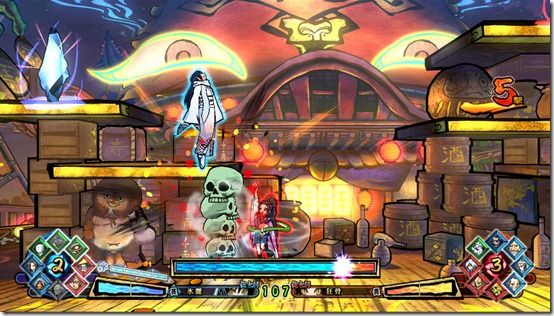
Nura: Rise of the Yokai Clan (Nura) released back in 2011 for the PS3, and is one of those confusing imports in that there is nothing about it that justifies it being an exclusive to the east. The gameplay is somewhat stylized alike the Super Smash Bros games (a universally loved gameplay-formula); the art-direction is slick water-colors roving along classic Japanese "wood-block" prints; and there is just so much stuff to simply do that surely western reviewers would have been praising Nura consistently in that there is just so much variety and replay-value packed into this misleadingly simple-looking party-fighter.
That said, Nura is very Japanese. While I cannot read Japanese there is an all-together evident focus on mythological and feudal Japan, be it by the characters themselves or the levels; in the title, though, is the keyword that may have been the overall reasoning why Nura was never picked up for an English release: Yokai, which are essentially a mammoth assortment of Japanese spirits, demons, monsters, and just about anything supernatural, with most of them being steeped in local legends also. As a big portion of what makes Nura so exciting is managing and selecting a team from the more than 100 yokai available inside the game, something that would have neither intimacy nor meaning to western gamers who don't know anything about yokai, I think that the rationale was that it just wouldn't be a well-received title due to its cultural focus--- which is unfortunate because that is absolutely not true. Personally, I've read only one book about these Japanese monsters (called Yokai Attack!, which is interesting because Matt Alt, one of the writers behind Yokai Attack!, is also responsible for the translated versions of Nura: Rise of the Yokai Clan's manga), and, to be perfectly honest, I didn't absorb any of the information after reading it--- that said, even though I had no idea who or what the monsters were in Nura, I was still impressed and inspired by using them, and had a terrific time trying them all out just to see who they were. Despite them being steeped in Japanese cultural myth, I still "liked" them just as much as anyone else could; freakish skeleton monsters two-stories-high tearing up from the ground and slamming the world into earthquakes is something any person can appreciate, I believe.

As mentioned above, Nura has a base that is somewhat similar to the Super Smash Bros style. As a party-stylized fighter, Nura has only two attacks for the player, which are a physical attack like punching/kicking, and a unique attack for each character; this can be shooting giant ice-blocks across the map, setting up explosive traps, or just lunging with a spear. It all depends on the character, and of the 12 available (and two unlockable) there is a highly noticeable degree of variety between them, even if there are only about 10 total attack options each character can do. A smaller scope of options may seem shallow, but the developers made sure to make that lesser assortment more meaningful, and truly it brings out each character in surprisingly lively and more intimate ways when playing as them.
Also akin to Super Smash Bros is the level design, which is basically a series of platforms scattered throughout with the occasional level-designed intrusion, whether it's a tsunami suddenly wiping out the lowest tier or a storm casting javelins of lightning across players' paths. For the most part the levels are mostly compact though, and while the background images can be highly inspiring and filled with wonder, the actual plane that players will be playing on is just a series of tiers that aren't remarkable beyond some few destructible platforms. The levels look gorgeous and are independent visually from one another, but what the player actually interacts with is, unfortunately, about the same throughout them all. That said, each map does have unique placement of "Shima (magic stones)," and it is here that Nura absolutely shatters the idea of it being a Super Smash clone and storms through with a series of exceedingly unique gameplay options.

As any fighting game, the point is to defeat your opponent. In Nura, the way this happens is by pushing a gauge (displayed at the bottom) fully to your favor, which is done by knocking out your health-bar-less opponents X amount of times. As expected, there are two special attacks per character in Nura, which become available as you fill up a separate gauge; for Nura, these special-attacks are probably going to be the player's kill-shot most matches. To build up special attacks there is the typical route of just hitting your opponent and being hit by your opponent, but there are also shima scattered throughout each level. Hit them a few times and they become yours; while each one helps boost the speed of your special gauge, collecting all of them ratchets it up considerably. The shima create a totally new playing-field for what would otherwise be a simple party-fighter; as special-attacks are extremely powerful, building up the meter in the fastest way possible is a wise choice. Oftentimes, even when against the computer, the match will not be so much about slamming each other with attacks, but navigating the map in pursuit of claiming stones. Finding yourself dodging your opponent and focusing on stones instead is not a rarity, and pastes a new, enjoyable layer of skill to achieving victory.
Most unique about Nura is how not alone you are. Sure, the match may read as a simple One-Versus-One or Two-Versus-Two, but really it's a Eleven-Versus-Eleven, or Twenty-two-Versus-Twenty-two. Going into a match gives you the option of bringing one or two "assist" characters with you, which is essentially an AI team of the fleshed in-game characters. You control these by "activating" them with either the circle or X button, where their tag-along, ghostly silhouette is suddenly in color and just as much a part of the match as you are. Still, it's a decision that requires some attention; when active, your AI characters can be knocked out and used to enhance the gauge toward your opponent's victory no different than you yourself being knocked out. Furthermore, once activated, your AI companions are not simply "assisting" you; if you run off on the map to find stones they're going to remain assaulting the enemy; whether or not they lose is wholly up to the skill of your AI in contrast to the skill of your opponent. It's a give-and-take engine; while useful, it may equally be destructive, and that dilemma of perhaps speeding along either your victory, or defeat, instills a highly exciting sense of the gameworld existing on its own, and not just at your leisure.

But that would amount to only a three-vs-three, in terms of a one-vs-one match; but there's much more. Rather, that 3-V-3 becomes an eleven-vs-eleven when you take into account the option of bringing in a team of 8 highly unique "yokai," the above-mentioned Japanese monsters. You create your team of yokai in the form of an 8-card deck, and activate them by pointing the right-joystick in the appropriate direction mid-match. The yokai are all extremely variable; one may be a two-foot high kappa who makes a quick, single tackle at the opponent, but others can be an outrageously large bull that storms throughout the entire level cloaked in swirling dark flames, or a vicious tengu who dives claws-out at your opponent repeatedly. Each of the yokai are extremely variable, with some assisting the player, attacking the opponent, or even stalling the victory gauge for a short amount of time. Once activated though, each yokai enters into a cool-down state that varies independently from one another, creating yet another simple, yet highly suspect to craft and consideration, layer of gameplay strategy.
Nura, like other fighters, upholds traditional modes as Story, Score Attack, Training, and Online. Most notable of these is the Challenge mode though, which is a robust assortment of unique challenges that genuinely teach the player to utilize team-members, yokai, shima, and other in-game elements in more exotic and strategic ways. There's well over fifty of these challenges, and lengthen the game in a thoroughly meaningful way, and not just artificially.
Nura is the real-deal; despite appearing as a simple party-fighter it is host to some of the more unique gameplay-elements to ever grace a fighter, and no matter it being based off a manga this is certainly not some pop-culture "cash cow" entry neither. Outside of the level layouts being inspired, everything about Nura has struck the right chords for an independent fighting game; a highly unique and satisfying gameplay system, plentiful replay value, and an eclectic cast of characters that vary greatly from one another but are without advantage/disadvantage. The only hesitancy in picking up Nura is that the online-community is simply non-existent; if you're going to desire playing online than you're going to need to sleuth around the Internet for others to party up with. Still, even without an online community, Nura stands more than firmly on its own, and is absolutely worth being experienced.

Language-Barrier
Nura sits somewhere at 80/20 with the language-barrier. There won't be any trouble in playing Nura at its fullest, and while setting up Yokai decks will first appear intimidating it's really a cinch with just some trial-and-error. No; where the language-barrier is prominent is in the mentioned Challenge Mode, and in deciding on which yokai to use in your deck. For challenge mode you're going to be utterly lost; for those wondering, there is almost zero katakana usage, and so unless you can read kanji understanding exactly what the challenge expects from you is going to be little more than a guessing-game. Most of them follow about 5 patterns, but it's still going to be a pain playing it blindly. As for yokai decks, the issue here is that there are over 100 of these monsters, and each of them do an action of their own. Whether a yokai is offensive, or a buffer, or defense, or a stage-variable is not going to be understood until you actually use it. This isn't really an "issue" as experiencing all of the yokai is a treat, but it can be a hindrance for those who want to just build the deck they desire without having to do trial-and-error.
Still; actually playing the game, which is attacks and special-moves and all the yokai fun, is 100% possible without knowing a lick of Japanese.

Import Impossible - The Language Barrier Wins...

I've developed a basic system to writing about imports exclusive to a language I don't understand: if I can play it despite the language, write about it. If I can't, then don't.
That said, it's important to note which games hold firm roots in language-required structures or not, particularly because there's nothing that separates those that do and don't as being desirable. While I've neglected to write about these titles (because I have nothing to say), I'm going to compile a brief list here just to give the basic low-down on those that defeated me.
*Note: I've been learning Japanese on-my-own for about a year collectively (meaning much longer, but that I'm terrible about sticking with it), with breaks between and long gaps of not knowing where or how to continue learning. I wouldn't put my understanding of Japanese even at an Elementary level, and so if you think you're somewhere around an Intermediate range these games might just be more accessible for you. Then again, maybe not.*

7th Dragon 2020-II
This one might seem pretty obvious, seeing as the 7th Dragon series is a hardcore "Job-Class" JRPG. No less, like the rest of the games in this list, despite 7th Dragon 2020-II being, indeed, a hardcore JRPG exclusive to the Japanese language--- I mean, it looks like a downright bad-ass hardcore JRPG exclusive to the Japanese language, and I just had to give it a whirl.
If you're wondering why I chose the sequel to 7th Dragon 2020 instead of the original--- it's because it was cheaper.
Job-Class, 1st-Person JRPG that it is, I was actually able to get into the "swing" of things relatively easy. While I could not comprehend the long-term positives/negatives of the several class types, for the most part I was able to recognize swiftly what it was that separated my Samurai, Destroyer, and Trickster apart from one another, and had no issue discovering what special abilities did overall.
No; the issue with 7th Dragon is one that is the constant complaint throughout this list; a dialogue-based revealing of where you need to go, or maybe how you need to go there, or with what you need to go there with; something that is strictly impossible to understand unless you can read the language. Within the first 2 hours I hit a point in 2020-II that had me doing circles around the relatively large home-base (with lengthy load-times between each floor also, mind you) before finally talking to the right person. For this I was rewarded with an equally uncertain person or place to go and so spent another hour just trying to do that.
Eventually I got to play an entire dungeon, and even fight one of the dragons one would expect from a title called 7th Dragon--- but, the moment I was done and back at home-base, I was again told to go somewhere and just never could find out where that was.
I don't know if it's import-impossible, but this game is an absolute chore if you don't understand Japanese.

Grand Knights History
Borderline have nothing to write about Grand Knights History other than that within the first hour I was totally lost as to where to go or what to do. Combat was typical turn-based goodness, loaded with that Vanillaware animation charm, but without having any direction what-so-ever I was truly up against a wall almost immediately.
I later learned that a large portion of what made this game so great was playing it online. Exactly what you did online I don't know, although it has recently been revealed that the servers for GKH are coming to an end. So while I never have the online-portion a chance, at this point it doesn't matter; personally, I could not get anywhere in the single-player portion, and as there will soon no longer be an online mode, I'd say this game is downright strictly impossible for the non-Japanese-understanding.

Akiba Strip


Akiba Strip was probably the biggest bummer for me. Right away the game is loaded with lengthy dialogues and all sorts of "exclaimed" and "tell me more" expressions. Afterwards I was finally allowed to do a little bit of running around Akihabara, aggressively stripping school-girls and armed policemen alike, but it was unfortunately a bit shallow. I wanted to progress; I wanted to strip the important, more materialized characters (you understand, yes?) that would naturally come with the main-plot.
And that's where it slammed me right to the friggin' ground. Finding the location of the first key-point was a challenge in itself (nothing on the map; no "where to go" hints), but afterwards I was totally, completely lost about what to do. I talked to everyone in the city, went in every store--- but nothing.
Actually, about three months ago, I was able to find out what to do next by using Yahoo Answers. Turns out you had to wear a friggin' bear costume and then talk to a certain somebody--- this, quite simply, was something I would never have understood to do, and from what I understand the rest of the game is loaded with quirky and bizarre situations just like this.
Import-totally-Impossible.

Senritsu no Stratus
Again, this was another title that stumped me due to "place of interest" being inserted somewhere or another in the dialogue between important characters. Honestly though, I didn't give this game anywhere near as much a chance as I did 7th Dragon 2020-II, because by the time I got around to playing this I was getting rather fed up of my persistence on buying RPG's in a language I didn't understand.
I had fun with what I was able to play with Senritsu no Stratus; it's an action RPG that runs on a 2.5d plane akin to most brawlers. While the backgrounds are somewhat bland there was a good assortment of color and activity with the individual models themselves, and special attacks, which incite an on-screen anime face-portrait, were pretty exciting to witness also. For the PSP, this is one of those rare action RPG's that are a genuine product--- but, again, it is an RPG, and one that expects you to understand the language as the overall theme and progression is decidedly mature and sophisticated.
It might be okay to import, but again; you are 100% going to end up lost at some point, aimlessly going places and talking to NPC's--- it's just not worth it, because any game that is designed in such a way is probably focused on telling a quality story alongside the gameplay. Missing so crucial an element in a title such as this turns the gameplay experience, however fun, unfortunately shallow.

Conception: Ore no Kodomo o Unde Kure!!
Simply by looking at the cover of this game there is a readily apparent reality that this is based heavily off of characters. As the main character is a young man, and all of the side-characters are girls, and that the game is titled Conception, I think it's obvious that this game is, indeed, a dating sim (of sorts) wrapped around a highly unique JRPG system. For anyone who has not seen a dating-sim in action, it goes like this:
Dialogue-Dialogue-Dialogue-Make Dialogue Decision-Much, much, much more dialogue.
This might seem like an obvious "No-No" for any non-Japanese-understanding gamers mildly intelligent, but unfortunately I am not quite that. Rather, I was really impressed by the combat of Conception, which has you going into this alternate world with your theoretical children from the girls you've dated/slept with, and battling monsters inside of a 4-sided circle, where you can warp around and flank/surprise enemies with your plentiful gang of children. It reminded me a lot of The Last Remnant, a flawed game that I was still crazily impressed by, and so I allowed that totally unreasonable similarity blind me into buying this.
But, to be totally honest, I barely even played Conception before selling it. For those interested in the combat there is a demo available, and from it you can take a guess as to whether or not you "get" it. By using a dictionary I was able to grasp the tutorial's key-components, but what really put this game off for me is exactly what I said in the first paragraph; the game is all about maintaining and establishing relationships with girls of the several zodiac signs, and while there is the possibility of doing this correctly by simple trial-and-error--- I mean, it just wasn't "fun" for me. I have no idea if the story is enthralling or not, but I certainly wanted to experience it rather than just guess.
Conception is equally based off of dialogue-immersion as it is gameplay, I suppose. If you don't know Japanese, than you're going to be missing out on 80% of the game. Even though it might be playable without knowing Japanese, I just don't believe it's worth it.